
A manager closes the door of a meeting room to talk about a sensitive hire, and someone at the next desk can still follow the conversation. Down the hall, a team on a video call keeps asking the other side to repeat themselves, because the room is so lively with echo that nobody is clear. These two problems feel alike, but they are not the same problem, and they do not share a solution.
Offices in Toronto get noisy in two distinct ways: sound that bounces around inside a room, and sound that leaks from one room into another. Knowing which one you have is the whole game.
Echo inside the room versus speech leaking through it
Hard surfaces such as glass, painted drywall, polished floors and bare ceilings keep sound alive. Voices bounce, overlap and blur, so the room feels loud and speech gets harder to understand. That is an absorption problem, and it is solved by soaking up reflections within the space.
Speech privacy is a different issue. Here the room may sound fine to the people inside, but conversation passes through walls, over the top of them or under doors to the people outside. That is a blocking problem, and absorbing echo does very little for it. Our page on sound dampening versus full soundproofing draws the same line in more detail.
Where speech actually escapes
People tend to blame the wall, but the weak points are often elsewhere. Partitions that stop short of the structural deck above, instead of continuing up to it, give sound an open path across the top, and speech passes over the wall as easily as through it. Gaps around the base of a wall, around pipes or ducts, and at the edges of glass or lightweight partitions do the same.
Doors are the other common leak. A door that is lighter than the wall around it, or that does not seal at the edges and bottom, can undo a well-built partition. The honest view is that a room is only as private as its weakest path, which is why we look at the whole boundary of the space rather than just the face of the wall.
Meeting rooms, phone booths and open plan
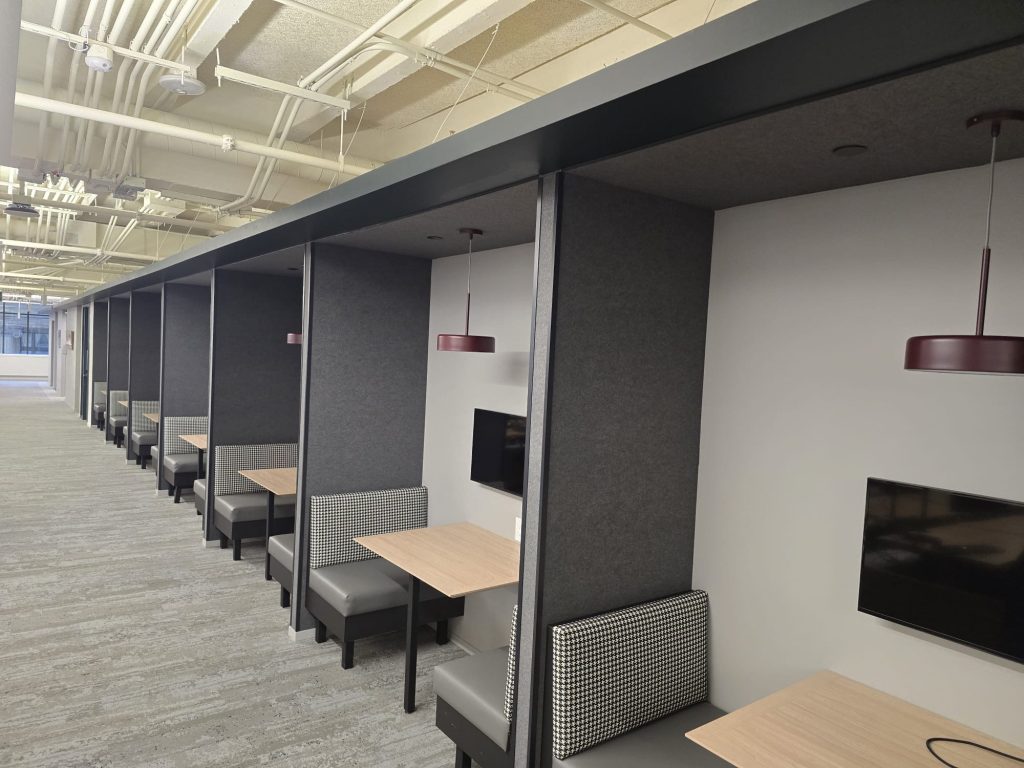
A boardroom or meeting room usually needs both things: enough absorption that remote participants can understand people clearly, and enough isolation that the discussion stays in the room. Small phone rooms and focus booths are the same problem in a tight space, where privacy matters and echo builds up quickly.
Open-plan areas are different because there are no walls to build. The aim there is to reduce how far speech carries and how long it lingers, so that colleagues can concentrate. That is mostly absorption and layout, and expectations need to stay realistic: an open office will not become a private one.
Acoustic panels and baffles: a complement, not a substitute
Custom acoustic panels and ceiling acoustic baffles are very good at what they do, which is taming echo and making speech clearer inside a space. They come in different types, colours and sizes and can be designed to suit the look of an office.
What they cannot do is stop a conversation from reaching the next room. In many offices the best result comes from using both: building or improving the boundaries that block sound, then adding absorption inside the rooms that need it. The order and balance depend on whether your main complaint is echo or privacy.
What a professional looks at first
A sensible office project starts by identifying what people are really complaining about, then walking the space to find the paths. That means looking at how partitions meet the structure above, how doors seal, and where services pass through walls. The design follows from the findings, and it is often worth tackling the rooms with the greatest privacy needs, such as HR, finance or client meeting rooms, before anything else. Treating everything at once is rarely necessary, and a plan built around the real problem spots keeps the scope sensible.
City Soundproofing handles commercial soundproofing for offices, medical and legal offices and other commercial spaces across Toronto and the GTA, and our general overview of what actually works for soundproofing explains the thinking behind the approach.
Frequently asked questions
Speech usually leaks around the weak points of the room rather than only through the wall face. Typical culprits are gaps at the ceiling line, around services and at the door. A professional assessment finds the paths and recommends how to deal with them.
No. Acoustic panels absorb echo inside a room and improve how clear speech sounds, but they do not block sound passing into the next room. They work best alongside measures that address the walls, ceiling gaps and doors.
Hard surfaces such as glass, drywall and bare ceilings reflect speech, which blurs it for the people on the other end. Adding absorption in the right places can make the room much easier to understand.
It can be made calmer, but not private. Absorption and layout can reduce how far speech carries and how long it lingers, though without walls it will not match the privacy of an enclosed room.
Yes. A door that is weaker than the wall around it, or one that does not seal properly, can let a lot of speech through. Door soundproofing and replacement are part of treating a private room.
If your meeting rooms leak conversation or echo, get in touch with City Soundproofing and we will help you work out which problem you have and how to address it.