

You can hear the television next door as if it were in your own living room. Or you can make out every word of a phone call from the neighbouring office. The wall between you looks solid, so it is natural to wonder how so much sound is getting through it.
The answer is usually that most walls were built to hold up a building and divide a space, not to stop sound. Once you see where the sound is actually going, the reasons that quick fixes disappoint start to make sense, and so does the way a professional approaches the job.
How an ordinary wall lets sound through
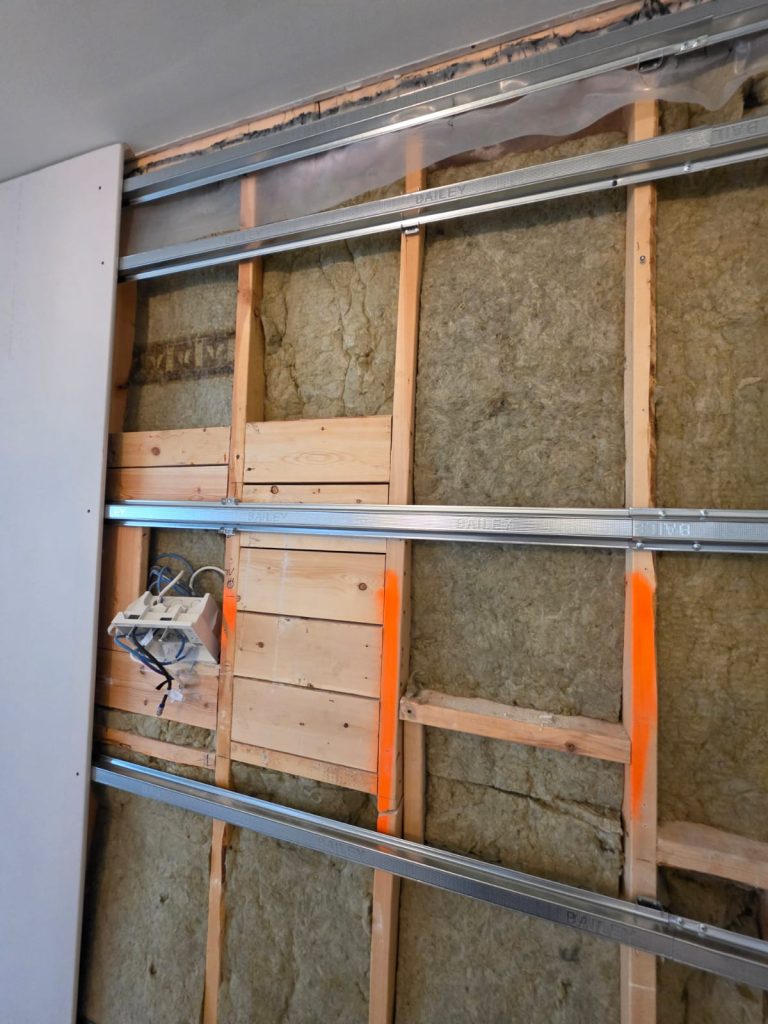
A typical interior wall is a light frame covered with a thin layer of board on each side. Sound is vibration, and when voices or music hit one face of that wall, the board vibrates and passes the energy straight to the studs, which hand it on to the board on the other side. The hollow cavity in between can even make things worse, because it behaves a bit like the body of a drum.
Then there are the gaps. Sound behaves much like water: if there is an opening, it finds it. Electrical outlets, light switches, joints where the wall meets the floor or ceiling, and small cracks that nobody notices all let air, and therefore sound, slip past. A wall that is otherwise decent can be undone by a handful of small openings.
The principles that actually reduce wall noise
Good wall soundproofing is not one product. It is a handful of well-established acoustic ideas used together. Mass makes a wall harder for sound to shake. Decoupling means separating the two faces of the wall so vibration cannot travel straight across the studs. Damping takes energy out of the vibration inside the layers. Sealing closes the air gaps. And absorbing material inside the cavity soaks up sound that gets into it instead of letting it bounce around.
Each of these does a different job, which is why leaving one out limits the result. Extra mass without sealing leaks around the edges. Sealing without decoupling still lets vibration travel through the frame. Our page on wall soundproofing describes how we approach this for walls in homes and commercial spaces.
Why paint, blankets and stick-on products fall short
Paint adds almost nothing. Moving blankets and decorative hangings soften the sound inside the room, but they are far too light to resist sound passing through a wall. Anything stuck to the surface of an existing wall leaves the structure behind it exactly as it was.
The same goes for filling the cavity after the fact. Foam or cellulose pushed into a finished wall does not address decoupling or mass, which is covered in more detail in our explanation of why cellulose and foam fail for soundproofing. It is also worth knowing that sound dampening is different from full soundproofing, since a product that calms echo is often sold to people who actually need to block noise. Cheap and do-it-yourself attempts tend to fall short for these reasons, and a properly designed, professionally installed assembly is what changes the result.
When the wall is only part of the story
Sound rarely takes just one route. It can go around a treated wall through the floor, the ceiling, a shared door, a duct or a pipe, and this is known as flanking. You can build an excellent wall and still hear the neighbours because the sound has found an easier path alongside it.
That is one reason we avoid promising a particular outcome before the space has been assessed. The honest answer to “how much quieter will it be?” depends on the building, the type of noise and how many other paths are in play. In some homes a wall treatment is the whole answer. In others it is one piece of a larger plan.
What a professional assessment looks for
A good assessment starts with listening to the problem: which noise bothers you, at what time of day, and in which room. From there the job is to work out the path. Is it coming through the wall itself, through outlets and edges, around the wall via the ceiling or floor, or through a door?
The design then follows from that, whether it is a full wall assembly, work on the weak points around it, or a combination. Our residential soundproofing work follows this order, and the broader picture is laid out in our overview of what actually works for soundproofing in Toronto.
Frequently asked questions
Most interior walls are a light frame with thin board on each side, and the board and studs pass vibration straight through. Small gaps around outlets, edges and joints let sound through as well. A wall can feel solid to the touch and still be an easy route for sound.
Not in any meaningful way. Paint adds virtually no mass, and hangings mostly soften echo inside your room. Blocking noise from a neighbouring space takes changes to the wall assembly itself.
Not always. If sound is also travelling through the floor, ceiling, a door or pipes, it can go around the treated wall. A professional assessment identifies those other paths so the plan covers them.
We recommend professional design and installation. Details such as decoupling and sealing have to be done correctly throughout, and small mistakes can leave leaks that undo much of the benefit.
Yes, existing walls in houses, condos and commercial spaces can be improved. What is practical depends on the construction, the noise and how the space is used, so the first step is an assessment.
If noise is coming through a wall in your home or workplace, talk to City Soundproofing about an assessment. We will look at where the sound is travelling and recommend what makes sense for your space.